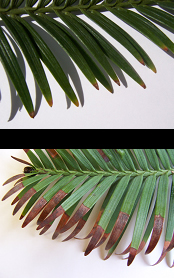
Has my Wollemi Pine died over the winter due to the cold temperatures?It seems in general that the trees need to have -12 to -15 degrees centigrade for fairly long periods to actually kill them (as seen in central Europe in the winter of 2010/11). There have been a handful of reports of trees not surviving this last winter in the UK but on investigation this has been in the main due to the trees already suffering from a fungal root disease called Phytophthora which is a wide spread and very common disease with the ability to affect many garden plants. A simple investigation should give some clues to the demise of your tree. Make a small 'nick' in the bark at the base of the tree and if there are signs of healthy white wood and greening on the inside layer of the bark it could be that the roots are still alive. If there is no sign of life then lift the tree and look at the roots they will be dark brown and there is unlikely to be any white or light brown 'healthy' root. If you hold a root hair in between your fingers and you can slide the outer layer of the root away from the inner core it is a sure sign that the tree has succumbed to Phytophthora.
What can I do?
Unfortunately Phytophthora is a widespread disease and quite hard to control. The addition of green compost into the growing media or soil can help. To our knowledge there are no chemicals available on the retail market to help control or prevent the disease. The Mycorrhizal fungus (Rootgrow) supplied with your tree also helps the root system to fight off Phytophthora but it will not prevent it.
For further information below is the Wiki link to the form of Phytophthora that Wollemi Pines suffer with: http://en.wikipedia.org/wiki/Phytophthora_cinnamomi
Alternatively the Wollemi Pine is known to coppice so if you think the top of the tree is dead or dying but the roots are OK, the best thing to do is remove the top of the tree either 3 inches above soil level or above the healthiest looking branch using sterile secateurs or a pruning saw. The tree will produce a white exudate which should seal the wound. Hopefully if the roots are still alive green buds will develop on the remaining trunk producing a bushy tree. If you want a more upright tree in the future it would be best to choose the strongest leader and remove any side shoots.
How can I give my tree the best chance of surviving a cold winter?
To give the Wollemi Pine the best chance of survival protect it from the worst of the winds during the winter it should flourish if left outside. If you are putting you tree in a container use a 50:50 mix of John Innes no3 and Ericaceous compost. Incorporate some slow release fertiliser into the compost along with the sachet of RootGrow that is supplied with the tree. Westland’s Feed All Slow Release is a suitable fertiliser (please follow the incorporation rates on the fertiliser packaging) Put a layer of crocs (pieces of broken clay pots) into the bottom of the container so that the drainage holes do not block. If it is outside make sure that the container is well drained and raised slightly off of the floor to aid the drainage. The Wollemi Pine starts to need copious amounts of water when the flush of growth arrives in the late spring, until then just make sure that the compost is just kept moist.
The new growth emerging on my Wollemi Pine is bronze or brown in colour.
We assume that because of the extremely cold weather this year that some of the new growth is emerging yellow, bronze or even brown; in the past we have observed that as this growth matures it returns to a green colour. The Wollemi Pine starts to need copious amounts of water when this flush of growth arrives. It may also be worth applying some slow release fertiliser into the soil around your tree. Westland’s Feed All Slow Release is a suitable fertiliser (please follow the incorporation rates on the fertiliser packaging). In the meantime an application of a proprietary liquid fertiliser to the tree will help.
If there is brown tipping on the leaves and you consider it unsightly it can be trimmed off using a sharp pair of scissors, this will have no adverse affect on the overall health of the tree. If the branch is dead it is best to remove it, for large diameter stems and branches (greater than 5cm) use sterile, sharp pruning equipment to match the size of the stem or branch being pruned. We have however seen more mature trees, having lost lower branches naturally start to produce new growth from lower down the trunk and this could be the case with your tree. |
| What is it? |
| What do they look like? |
| Where did the name come from? |
| Where are they? |
| How were they found? |
| How old are they? |
| Are they protected? |
| How can we help conserve the Wollemi Pine? |
| Where can I see a Wollemi Pine in the UK? |
Where can I buy one?You can order your Wollemi Pine in the UK now from the "Ordering" Section of this website, or by clicking the link above.
Prices start from £85 (inc. VAT) |
Wollemi Pine StockistsIf you want to be one of lucky few to receive a Wollemi Pine, then place your order for one of these rarities without delay to ensure delivery. You can order your Wollemi Pine today by clicking the link HERE. All Pines will arrive with an information booklet, care label, antique gold label badge and also a certificate of authenticity to prove that you have purchased a piece of genuine Jurassic history. The 3 litre pine is supplied in a stylish coloured, printed pot.
|
| What is the association between KPP and Kew? |
Who is Tony Kirkham?Tony Kirkham was born and raised in Darwen, Lancashire. After leaving home at the age of 16, Tony moved to Surrey to become a forestry apprentice. Here he got his first insight into working with trees and decided that he wanted to be a forester. He was advised against this as it was seen as a dying job in Britain and instead studied for his National Certificate in Horticulture (arb) where he qualified with the best practical marks in his year. Tony then moved to Hamburg as the Germans were pioneers in arboriculture in Europe at that time. Here Tony learnt a lot about tree management within urban and park environments and also in Hamburg Botanic Gardens.
Ironically, Tony came to Kew to escape trees and study for the Kew Diploma to broaden his knowledge in horticulture. An experience that he says was the highlight of his career, Tony graduated with honours, but more importantly he realised that trees were where his passion lay. Tony was the only student to be offered a job at Kew upon graduation, and he spent the next 14 years managing part of Kew’s arboretum. During this time, Tony completed many expeditions plant collecting in East Asia, with the aim of adding to the tree collection and replacing trees that were lost in the storm of 1987.
He currently holds a top in arboriculture – Head of the Arboretum and Horticultural Services at the Royal Botanic Gardens, Kew. Tony, and his team of over thirty staff and students are responsible for the management of over 10,000 trees in the living collection at Kew amongst many other responsibilities. Alongside this, Tony also manages to champion many other projects for the Royal Botanic Gardens, Kew, including achieving the ISO140001 award for sustainability in 2005, and hardiness trials of the Australian ‘jurassic’ tree to the UK Climate.
Tony Kirkham is recognised worldwide as an expert in arboriculture and is regularly asked to organise conferences and give lectures across the world. He is the author of two books. In his latest book, entitled ‘Plants from the Edge of the World’ (Timber Press, 2005), Tony shares his and co-writer and expedition partner Mark Flanagan’s experiences on expeditions. Tony is also the author of the indispensable reference guide to the ‘Pruning of trees, shrubs and conifers’ (Timber Press, 2004) and many other articles for a diverse range of publications. Tony has also made numerous television and radio appearances and now has his own series that will air on BBC Two in Autumn 2006, entitled ‘The Trees that made Britain’.
Tony recently ran in the ‘Treeathlon’ to support the Trees for Cities campaign for more trees in urban areas in the UK, and states “looking at trees anywhere in the world” as one of his hobbies, something that he regularly gets to indulge by working at Kew Gardens. It is clear that, to Tony, trees are more of a life passion than a job.
|
| Why are the tips of the leaves of my Wollemi Pine going brown? |
| How does the Wollemi Pine help to offset carbon footprint? |
How much CO2 will a Wollemi Pine sequester?This is a difficult question to give an exact answer to due to the fact that no 2 Wollemi Pines seem to grow in the same manner and the first tree was only planted in the UK in 2005. The typical form of Wollemi Pine in the wild is a tall long-lived tree that has a coppicing habit. Mature trees are usually multi-trunked with up to 100 stems of various sizes. The oldest tree in the wild is 1000 years old and has 100 trunks due to the ability of the tree to coppice. The Bill Tree; the tallest tree in the wild is 40 metres tall but this is because it is growing in a canyon. We expect Wollemi Pines in the UK to grow to an ultimate height of about 20 metres in good growing conditions.
To enable us to calculate the quantity of CO2 sequestered we must look to a close relation of the Wollemi Pine; the Hoop Pine (Araucaria cunninghamii) which has a density of 575Kg/cubic metre at 12% moisture content. The weight of a tree normally shrinks by about 10% in drying so it would be expected that the Hoop Pine will weigh about 630Kg/cubic metre when growing. Green Peace states on its web site that “One tonne of carbon in wood or forest bio-mass represents about 3.5 tonnes of atmospheric C02. Without going into atomic chemistry 100 Kg of dried wood contains approximately 45Kg of carbon; equivalent to 160Kg of atmospheric C02”
So we must assume that every 100Kg of growing tree would take in 160Kg of atmospheric CO2. Based on the figures above a single trunk of a mature Wollemi Pine with an average radius of 1 metre, being 20 metres tall should weigh 12,600Kg which equates to the tree having the possibility of sequestering 20,160Kg of atmospheric CO2 over 100 years, or 210Kgs per year
Out of interest the average carbon footprint in the UK is 9,400Kg per person per year. (Mark Lynas The Guardian, Wednesday January 24 2007) - So each person would need to plant about 45 Wollemi Pines per year to be Carbon neutral.
|
Why has my Wollemi Pine developed spots on its leaves?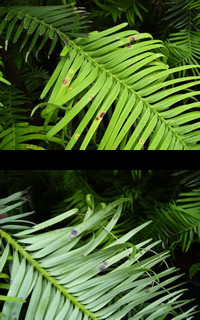 These spots or sap blisters are a fairly common occurrence and are completely natural; they are not evidence of a disease or insect attack and rarely affect the overall health of the tree.
It is assumed that they are a part of the same mechanism that helps the tree to produce the 'polar cap' but rather than sending the exudates to the growing tip they find their way out through the stomata in the leaves. |



 Top
Top